LADICIM hosts a conference on knowledge transfer in eco-sustainable concretes in Santander
On December 3, researchers, companies, CEDEX, and the Ministry of Transport will debate what is needed for lower environmental footprint concretes to reach construction sites
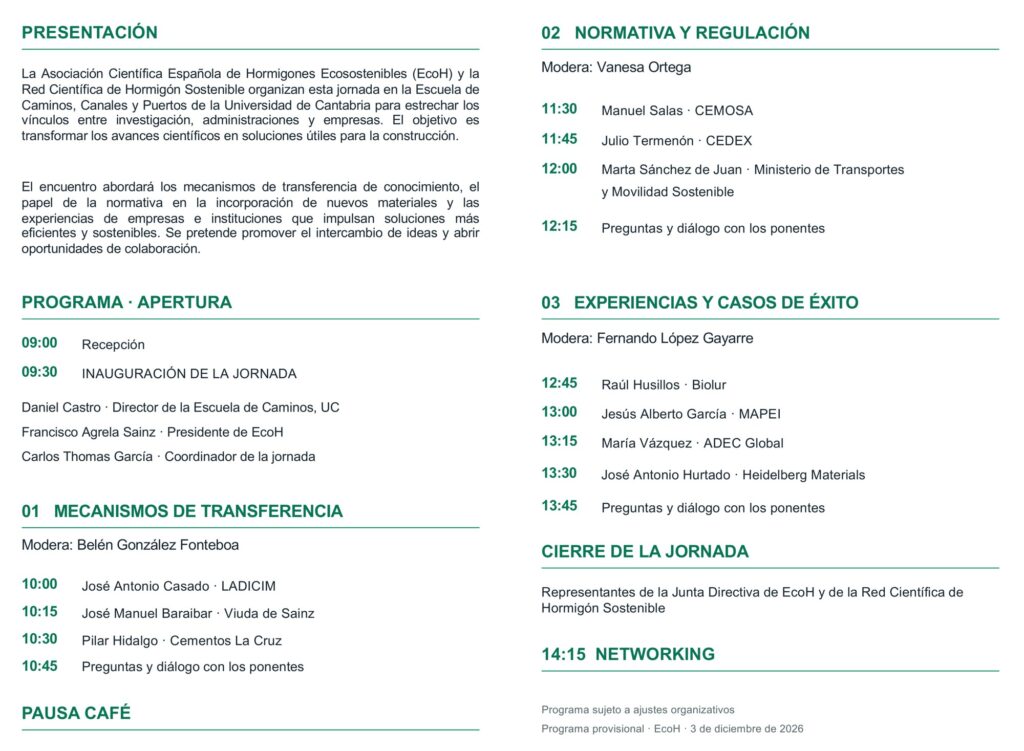
The Laboratory of the Materials Science and Engineering Division (LADICIM) of the University of Cantabria will host the technical conference “Knowledge Transfer in the Eco-Sustainable Concrete Sector” on December 3, 2026. It is organized by the Spanish Scientific Association of Eco-Sustainable Concretes (EcoH) and the Scientific Network of Sustainable Concrete, and will be held at the School of Civil Engineering, the Laboratory’s headquarters, in both in-person and online formats.
The meeting aims to strengthen the links between research, public administrations, and industry so that scientific advances are transformed into practical solutions for construction. Opening the event at 9:30 will be Daniel Castro, Director of the School of Civil Engineering; Francisco Agrela Sainz, President of EcoH; and Carlos Thomas, Professor at the University of Cantabria, LADICIM researcher, and coordinator of the conference.
“We understand knowledge transfer in every sense: from university to industry, from industry to university, and from both to society,” explains Thomas. “We want to learn from collaborative projects that have already yielded results so that future ones perform better. In this context, regulations are crucial, as they dictate which materials can be used and which cannot.”
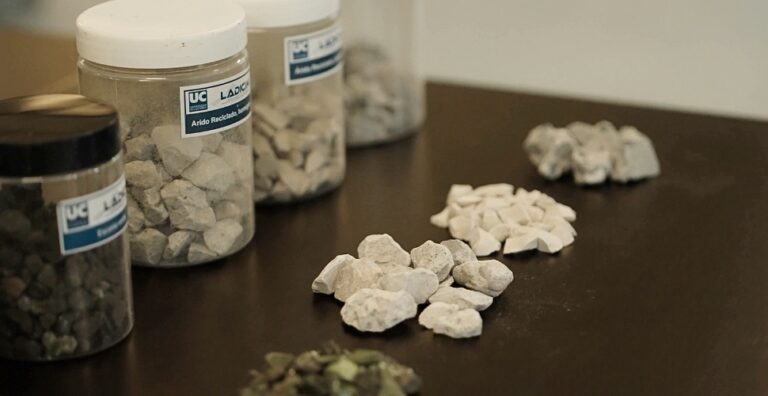
José Antonio Casado, Director of LADICIM, will open the first block, dedicated to knowledge transfer mechanisms, with a presentation on how knowledge from an accredited laboratory, specialized in mechanical and microstructural characterization, reaches companies and society. He will be joined by José Manuel Baraibar, from Viuda de Sainz, a company with which the Laboratory maintains a collaboration agreement on recycled aggregates, and Pilar Hidalgo, from Cementos La Cruz.
The second will address how new materials are incorporated into regulations, featuring Manuel Salas, from CEMOSA; Julio Termenón, from CEDEX; and Marta Sánchez de Juan, from the Ministry of Transport and Sustainable Mobility. In the third, Raúl Husillos, from Biolur; Jesús Alberto García, from MAPEI; María Vázquez, from ADEC Global; and José Antonio Hurtado, from Heidelberg Materials, will share corporate experiences with more efficient and sustainable solutions. The conference will conclude with closing remarks from representatives of the boards of directors of EcoH and the Network, followed by a networking session among attendees.
From recycled aggregate to floating offshore wind
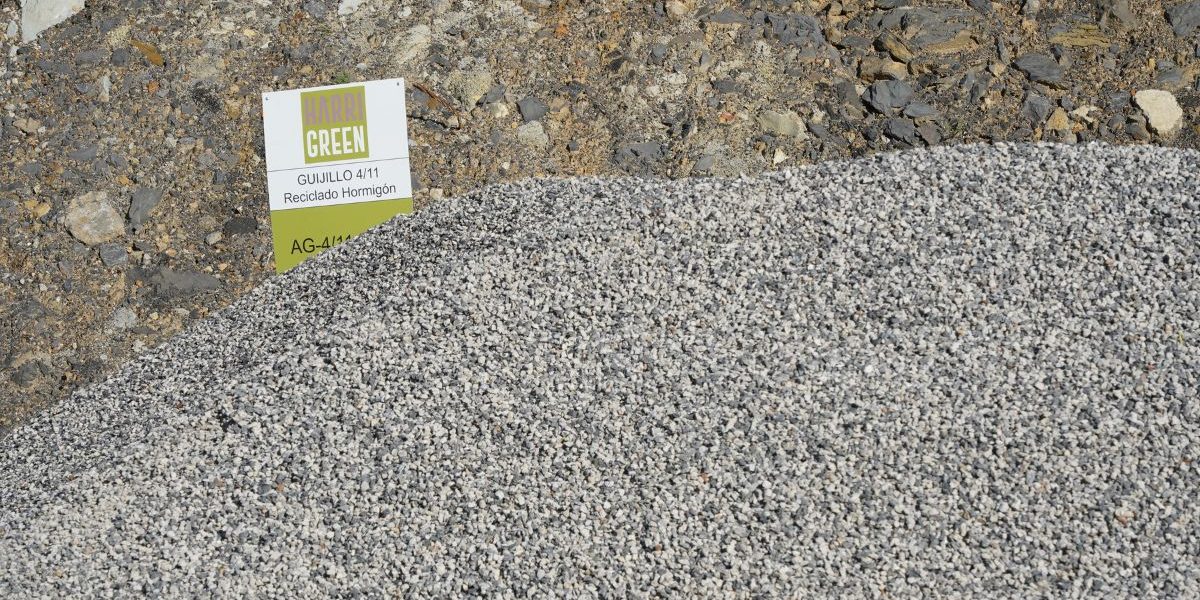
LADICIM is a founding member of EcoH, where it represents the University of Cantabria. Among its early works in sustainable concrete, the RECNHOR project (2006-2008) stands out; funded by the Ministry of Environment, it established the foundations for Spanish regulations on the use of recycled aggregates in structural concrete. Thomas, secretary of EcoH, also leads, alongside Nikola Tošić from the Universitat Politècnica de Catalunya, the working group finalizing the Spanish application guide for Annex N of Eurocode 2, which regulates recycled aggregate concrete in structures. The guide, commissioned by the International Federation for Structural Concrete (fib), is expected to be published in early 2027.
The Laboratory has extended its research to the marine environment, where metallic reinforcement deteriorates rapidly. In SEACOND, it has studied high-durability recycled concrete for marine structures. In ISOBARA, together with SEAPLACE and IHCantabria, it led the concrete durability tests for a floating offshore wind platform. And in ISOTACA, it investigates circular and self-healing concrete for these types of platforms.
Another avenue is the reduction of clinker, the cement component with the highest CO2 emissions. Together with the Components Technology Centre (CTC), in the Ecoflowing project, it formulates concrete using supplementary cementitious materials derived from waste, aiming to cut its carbon footprint by more than 20% compared to standard mixes. In CO2MCHRETE, funded by the CDTI Missions program and led by Técnicas Reunidas, it has validated, alongside Ferrovial, the mix designs for concrete and mortars manufactured with cements produced from slag and captured CO2. Cementos La Cruz also participated in this consortium.
Santander is the third host city for these technical sessions, following those held by EcoH and the Network in Barcelona and Granada. Registration, which is also mandatory for attending the session online, is open on the association’s website.
Más Noticias