
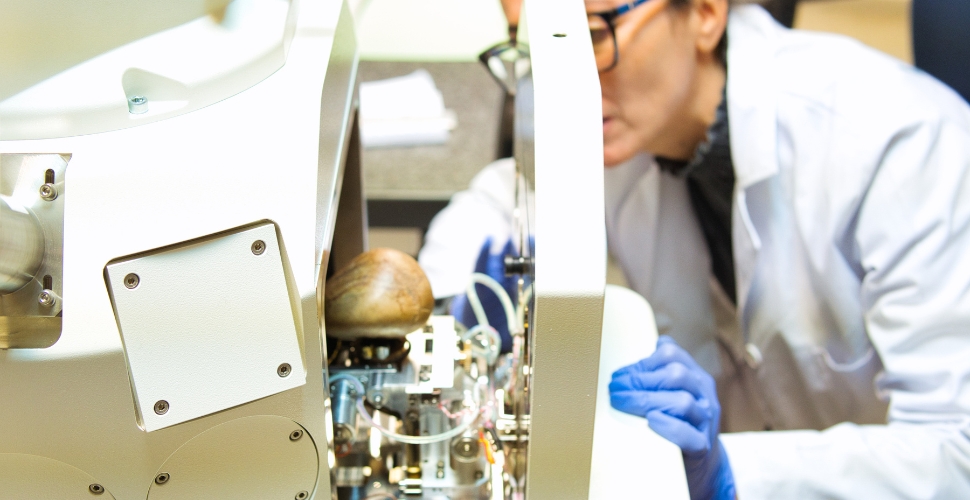
LADICIM presents an algorithm in Atlanta that predicts the useful life of nuclear power plants with 22% greater accuracy
The University of Cantabria laboratory presents a methodology, developed with partners from the U.S. and Japan, to the ASTM world committee to mitigate the lack of physical data in long-term operation reactors
The Laboratory of the Division of Materials Science and Engineering (LADICIM) of the University of Cantabria recently participated in the main forum for debate on the future of nuclear energy in Atlanta, Georgia. There, before the ASTM International E10 committee—the body that sets global technical standards—the Cantabrian center took a prominent role by proposing a mathematical solution to a physical problem: the scarcity of samples to evaluate reactor aging beyond 40 years. The proposal, an algorithm called KNT, allows for a reduction in the error of safety predictions by more than 22% compared to the current standard.
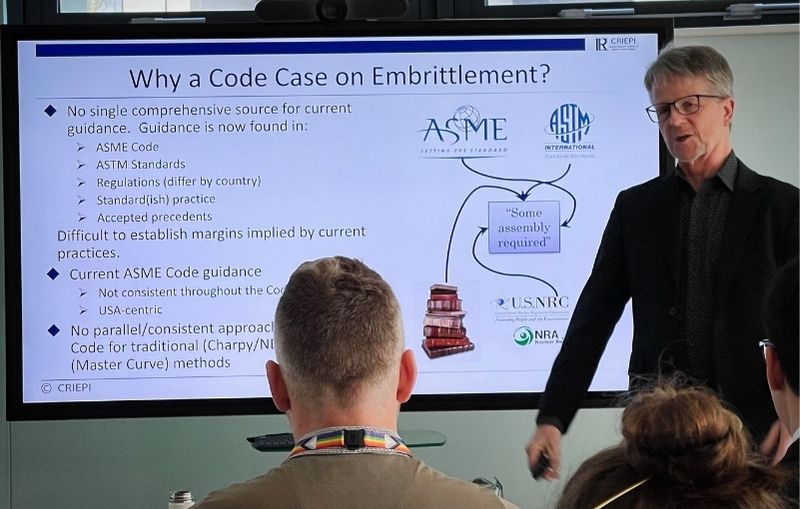
The meeting took place during the Symposium on Structural Material Challenges for the Long-Term Operation of Nuclear Power Plants. During the technical sessions, the renowned expert Mark Kirk (Phoenix Engineering Associates) was the voice in charge of presenting the results of this strategic alliance to the plenary, forged side by side with the team of Professor Diego Ferreño and the Central Research Institute of Electric Power Industry (CRIEPI) of Japan. Their joint work directly addresses the main obstacle to Long-Term Operation (LTO): how to certify that a power plant can operate up to 80 years when it was designed to last half that time.
Data Mining vs. Physical Scarcity
A plant’s safety depends on the integrity of the reactor pressure vessel, which is subjected to constant irradiation that embrittles the steel. Traditionally, surveillance is based on extracting “surveillance specimens” from inside the reactor. However, the stock of these samples is finite, and many old power plants no longer have sufficient material to cover the new decades of planned operation.
“The original surveillance programs did not contemplate such extensive periods,” warns Ferreño. This physical limitation generates critical information gaps: “The specific data for each plant is limited, which makes it difficult to accurately project the material’s long-term behavior.”
LADICIM’s solution is not to obtain new samples, which is unfeasible, but to exploit the industry’s “collective intelligence.” The presented methodology relies on global databases such as PLOTTER, which accumulates over 2,000 reactor records from around the planet, to infer what will happen in a specific plant.
KNT: The Search for "Technological Neighbors"
The novelty of the proposal lies in the search criterion. Until now, standards grouped materials by their chemical composition. The K Nearest Travelers (KNT) algorithm changes the approach: it looks for similarities in the evolution of damage. The system scans the worldwide database to find steels that, regardless of their origin, have reacted to radiation following an identical curve to that of the reactor under study.
Using metrics like the Area Under the Curve (AUC) or the Manhattan Distance (MD), the model identifies these “near travelers” (materials with an analogous degradation history) and uses their data to complete the information gaps of the local plant.
The figures presented at the symposium endorse the change in model. Compared to the current standard (ASTM E900-15), the KNT procedure cuts the uncertainty of predictions by more than 22%. “This is a substantial improvement in safety margins,” points out the project’s principal investigator. By refining the aim, operators can reserve the few remaining surveillance capsules for moments when they are essential, optimizing resources that are, for all practical purposes, irreplaceable.
Bringing this methodology into the heart of ASTM validates the Cantabrian technology at the highest regulatory level. The work consolidates a three-way alliance between the University of Cantabria, the Japanese industry (represented by researchers Y. Hashimoto and N. Soneda) and the American engineering firm (Mark Kirk and M. Erickson).
With more than 25 years of experience, LADICIM confirms with this development its evolution from traditional mechanical testing towards Materials Informatics. A discipline that, as demonstrated by previous projects like ENTENTE, is proving essential to sustain the operating license of nuclear power plants in an energy transition scenario.
Más Noticias

LADICIM leads the concrete durability testing in the Isobara project
The research, which also involves IHCantabria and Seaplace, aims to standardize a concrete floating platform for offshore wind energy. The Isobara project, which aims to
LADICIM collaborates on the guide to implement the European standards for recycled concrete in structures in Spain
The goal is to provide precise recommendations to optimize the design and execution of structures using recycled concrete, contributing to the transition toward more environmentally

LADICIM and IFCA use AI to automate graphite classification in iron foundries
Using convolutional neural networks, the new system identifies graphite morphology with high precision, overcoming the limitations of manual analysis and enabling more rigorous and efficient